
Case Study • Mobile App Modernization

Personal Safety App Rebuild: A Two-Phase Legacy Modernization With Node.js and Swift 5

AccelOne modernized a failing personal safety app in two phases. The work delivered a new Node.js backend, a dedicated media server for video, and an iOS migration to Swift 5.
Personal Safety Technology
Engagement: Legacy Backend Modernization, iOS Swift 5 Migration, and Media Server Development
Partnership: Dedicated Four-Person Team, Embedded Collaboration, and Two-Phase Delivery
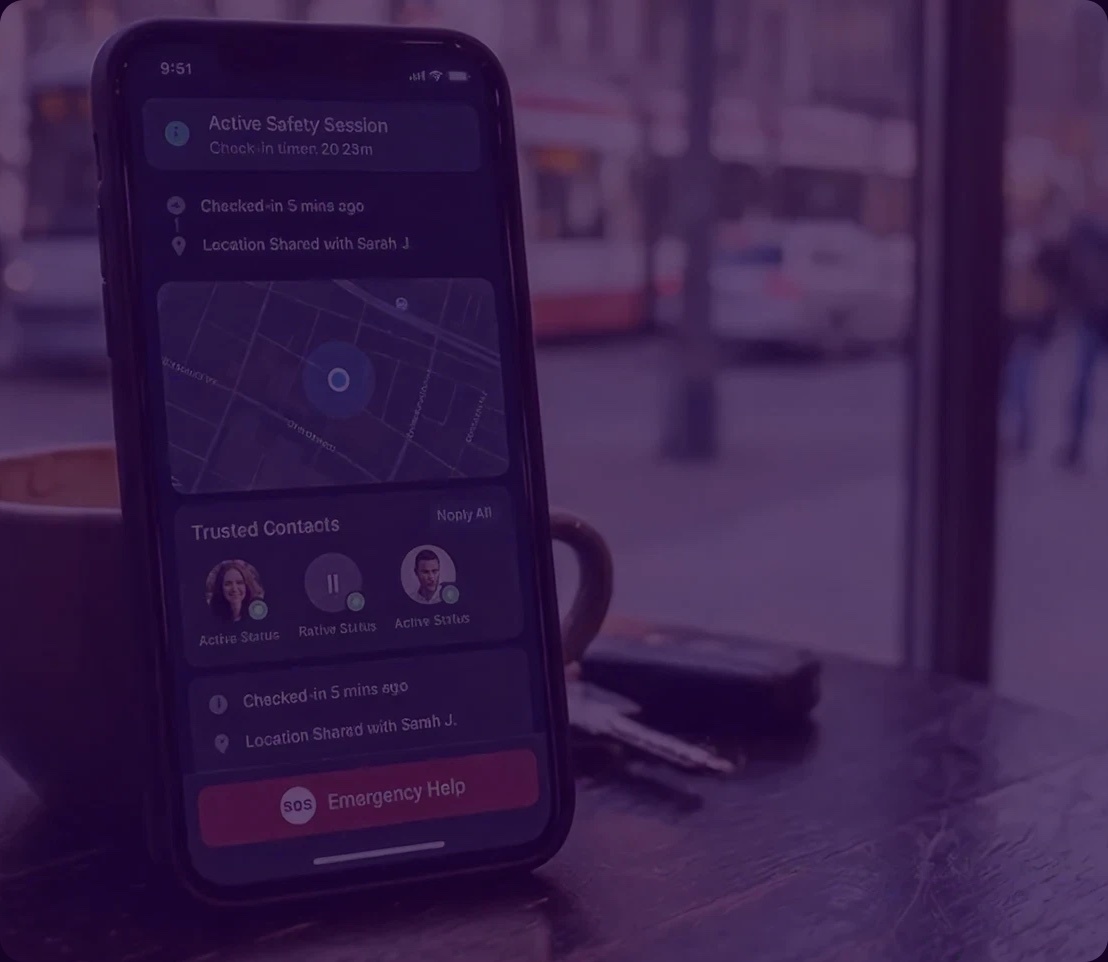
Smartphone on a café table showing a personal safety app with a live location map, trusted contacts, and an emergency help button
2 Phases
A parallel backend first, then a complete backend rewrite
4-person Team
Senior iOS, senior backend, technical project management, and QA
All features restored
Including video processing and sign-up
Weekly growth
Platform gaining new subscriptions every week
~0
Manual tagging remaining
Near-complete elimination.
~0
Manual tagging remaining
Near-complete elimination.
~0
Manual tagging remaining
Near-complete elimination.
Personal Safety App: application, modernization, migration

A personal safety app makes one core promise: reliable protection. When core features fail, that promise fails with them. AccelOne’s client had a personal safety app running on an outdated backend and mobile architecture that caused feature failures, high operational costs, and a poor user experience. The client needed to regain market share and grow subscriptions.

AccelOne embedded a dedicated four-person team with the client’s internal team and delivered the modernization in two phases. Phase 1 ran a new Node.js and Express backend in parallel with the legacy system. Phase 2 completed the backend rewrite, added a Node.js media server, and migrated the iOS app to Swift 5. All features now work as expected, and the platform gains new subscriptions every week.

Failing Core Features Behind a Safety Promise

The app’s legacy architecture caused feature failures, high operational costs, and a poor user experience. Video processing and sign-up were among the features affected. For a personal safety app, those failures put the core promise of reliable protection at risk.

The rebuild had its own constraints. The team had to reverse engineer the legacy code, plus extra components for the back-office website and events page, to rebuild the backend correctly. The new backend and media server also had to work seamlessly with the existing database and systems. The client needed a modern, scalable, and stable solution to restore and improve its features.

Search and tagging had become a serious bottleneck

With millions of videos, search and tagging had become a serious bottleneck.

challenge 01

Manual tagging didn't scale

Description here.

challenge 01

Manual tagging didn't scale

Description here.

challenge 01

Manual tagging didn't scale

Description here.

challenge 01

Manual tagging didn't scale

Description here.

Engineering Highlights

01

A Parallel Backend Before a Full Rewrite

AccelOne did not replace the legacy backend in a single step. In Phase 1, the team built a Node.js and Express backend alongside the legacy system, using the same database, and restored several app features. Video processing and sign-up issues remained.

Phase 2 resolved those issues with a complete backend rewrite on a modern infrastructure architecture.

02

A Dedicated Media Server for Video Processing

Video processing issues persisted after Phase 1.

AccelOne built a dedicated Node.js media server to handle video processing and rewrote most of the app’s video sections for better performance. Video processing is now faster and always available.

03

A Lean Team Embedded With the Client’s Team

AccelOne embedded a four-person team with the client’s internal team: a Senior iOS Engineer, a Senior Backend Engineer, a Technical Project Manager, and a QA Engineer.

The work started with a preparation phase to understand the app fully and identify critical points for testing and development. Rigorous stability and performance testing continued throughout development.

A hybrid AI video intelligence pipeline built for scale

Description here.

Key Impact: Cost Reduction by Three Orders of Magnitude

One of the most significant achievements of this engagement was the reduction of AI processing costs by three orders of magnitude.

By combining on-premises transcription models with selective use of commercial APIs, AccelOne designed a hybrid architecture that:

01

Card Title

Card description.

01

Card Title

Card description.

01

Card Title

Card description.

The result was not just faster delivery, but stronger alignment around how

Monetate builds and evolves its platform.

7-step AI pipeline

Each component is modular and optimized for cost and reliability.

Step 01

Step title

Step description.

Tag
Step 01

Step title

Step description.

Tag
Step 01

Step title

Step description.

Tag
Step 01

Step title

Step description.

Tag
Step 01

Step title

Step description.

Tag
Step 01

Step title

Step description.

Tag

Handing off these tasks to AI allowed senior engineers to focus more time on architecture, edge cases, and customer-impacting decisions. Quality remained non-negotiable.

As Austin puts it:

AI helps our QA team get from zero to 85 percent of their job much faster, so they can focus on the 15 percent where they add real value.

The outcome enabled operational acceleration without sacrificing discipline.

Woman smiling at her smartphone while walking through a city park at night

A Two-Phase Modernization Built Around Stability

AccelOne split the project into two phases, each focused on a different part of the app and backend. The solution comes down to four capabilities.

Backend Rebuild: A complete rewrite in Node.js and Express replaced the legacy backend with a modern infrastructure architecture. A parallel backend in Phase 1 restored several features before the full rewrite.

CAPABILITY 01

Media Server: A dedicated Node.js media server now handles video processing, making it faster and always available.

CAPABILITY 02

iOS Swift 5 Migration: The iOS app moved to Swift 5 with updated libraries and confirmed compatibility with the latest iPhones. Phase 1 also updated libraries and frameworks on both iOS and Android.

CAPABILITY 03

Crash and Bug Monitoring: Tracks app stability and performance across devices.

CAPABILITY 04

Open-source intelligence, cloud applied selectively

The pipeline combines open-source models with selective cloud services, running primarily on on-prem GPU infrastructure to deliver production-grade accuracy while avoiding cost, lock-in, and unpredictability.

Tech name

Description

Open Source

Tech name

Description

Open Source

Tech name

Description

Open Source

Tech name

Description

Open Source

This hybrid approach delivers production-grade accuracy while avoiding the cost, lock-in, and unpredictability of cloud-only architectures — making large-scale video intelligence economically sustainable at 2.5M+ video scale.

AI-powered video intelligence at massive scale

A searchable, time-addressable catalogue spanning millions of hours

What was previously locked behind sparse tagging and manual review is now discoverable at scale — while balancing cost efficiency with production-grade reliability.

before

Hours per batch of manual tagging

Hours per batch of manual tagging

Hours per batch of manual tagging

Hours per batch of manual tagging

after

Minutes of spot-check per batch

Minutes of spot-check per batch

Minutes of spot-check per batch

Minutes of spot-check per batch

The catalogue is now discoverable by:

Title

Description

Title

Description

Title

Description

Title

Description

Expanding the Partnership

As the early AI and UI initiatives gained traction, the collaboration expanded. AccelOne is now contributing not only to delivery, but to roadmap planning across AI, machine learning, and user experience initiatives.

Austin describes the ongoing dialogue as productive and forward-looking:

"As we work through these initial projects, having the teams weigh in on what the roadmap should look like next has been very productive. We've gained a great set of partners and feedback voices inside of AccelOne."

The partnership now operates at two levels:

  1. Accelerating current initiatives
  2. Accelerating current initiatives

For a platform operating at this level of complexity, that alignment matters.

A Model Built on Leverage and Trust

Monetate's goal was simple: Accelerate AI and UI initiatives without slowing the organization down.

What ultimately emerged was a partnership that increased leverage across the entire business.

Senior engineers were embedded quickly. Roadmaps moved faster. AI became part of daily workflows. Collaboration tightened across teams and time zones.

The engagement reduced friction and increased output.

And the relationship continues to expand, with AccelOne contributing to long-term direction beyond the initial delivery.

At this level of complexity, sustainable acceleration is not about adding more people. It's about embedding partners who raise the standard of how the work gets done.

Results & Impact

01
All app features restored and working as expected.
02
Stable, scalable backend, with most legacy problems resolved.
03
Faster video processing that is always available.
04
Sign-up issues resolved.
05
A much better experience for users on the latest iPhones.
06
Codebase on the latest languages and frameworks.
07
New subscriptions every week.

Business Impact

The client set out to regain market share and grow subscriptions. The platform now gains new subscriptions every week, and all features work as expected. The app delivers a reliable, seamless experience at lower operational cost.

The codebase now runs on current languages and frameworks, with better support for modern mobile OS versions. The app meets high standards for quality and security, which sets the client up for long-term success.

Modernizing a Legacy App While Core Features Are Failing

This engagement shows how to modernize a legacy app when core features are already failing. Running a new backend in parallel on the same database restored features before the full rewrite.

Moving video processing to a dedicated media server fixed the problem that persisted after Phase 1. A dedicated team embedded with the client’s own team handled reverse engineering, rebuilding, and testing as one effort.

A Modern Backend That Works With the Existing Database

The app now runs on a Node.js and Express backend with a modern infrastructure architecture. A separate Node.js media server handles video processing. Both work with the client’s existing database and systems. The iOS app runs on Swift 5, and crash and bug monitoring tracks stability and performance across devices.

Component Technology Role
Backend API Node.js and Express Replace the legacy backend with modern, scalable infrastructure
Media server Node.js Process video faster and keep it always available
iOS app Swift 5 Run on the latest iPhones with updated libraries
Mobile libraries iOS and Android frameworks Bring both apps onto current libraries in Phase 1
Data layer Existing database Serve the legacy and new backends during Phase 1
Monitoring Crash and bug monitoring Track stability and performance across devices

Frequently asked questions

What is legacy app modernization, and why did this personal safety app need it?
Legacy app modernization replaces outdated backend and mobile code with current languages, frameworks, and infrastructure. AccelOne’s client had a personal safety app whose legacy architecture caused feature failures, high operational costs, and a poor user experience. Video processing and sign-up were affected, which put the app’s core promise of reliable protection at risk.
Why did AccelOne split the modernization into two phases?
Phase 1 updated mobile libraries for iOS and Android and built a Node.js and Express backend in parallel with the legacy system, using the same database. That restored several features, but video processing and sign-up issues remained. Phase 2 fully rewrote the backend, built a Node.js media server, and migrated the iOS app to Swift 5 to resolve them.
What technology stack did AccelOne use to modernize the personal safety app?
AccelOne rebuilt the backend in Node.js and Express with a modern infrastructure architecture. A dedicated Node.js media server handles video processing. The iOS app runs on Swift 5 with updated libraries, and crash and bug monitoring tracks stability and performance across devices.
Why did the personal safety app need a dedicated media server?
Video processing issues persisted after Phase 1. AccelOne built a dedicated Node.js media server for video processing and rewrote most of the app’s video sections for better performance. Video processing is now faster and always available.
What team did AccelOne use for the app modernization?
AccelOne deployed a dedicated four-person team: a Senior iOS Engineer, a Senior Backend Engineer, a Technical Project Manager, and a QA Engineer. The team was embedded with the client’s internal team, starting with reverse engineering of the legacy code and the components behind the back-office website and events page.
What were the results of AccelOne’s personal safety app modernization?
All app features work as expected, and the platform gains new subscriptions every week. The new backend and media server are stable and scalable, video processing is faster and always available, and sign-up issues are resolved. Users on the latest iPhones get a much better experience, and the codebase runs on current languages and frameworks.

Real outcomes, measurable impact

From FinTech to Government and Enterprise, we help organizations achieve faster delivery, higher quality, and sustainable innovation.

Modernize the App Your Users Depend On

Talk with AccelOne about rebuilding a legacy backend or mobile app with a team that works inside yours.

Talk to an Expert