Case Study • Governance Platform

A1 Hub: Enterprise AI Orchestration and Governance

A1 Hub is an enterprise AI orchestration and governance platform built by AccelOne. It brings knowledge, model integrations, access controls, and usage monitoring into a shared foundation for business applications.
Model Integrations Platform
Built by: AccelOne Oct 2026
Applications: Kyber (Proposal Intelligence) and Nebulous (Recruiting Intelligence)
Status: Live and actively expanding
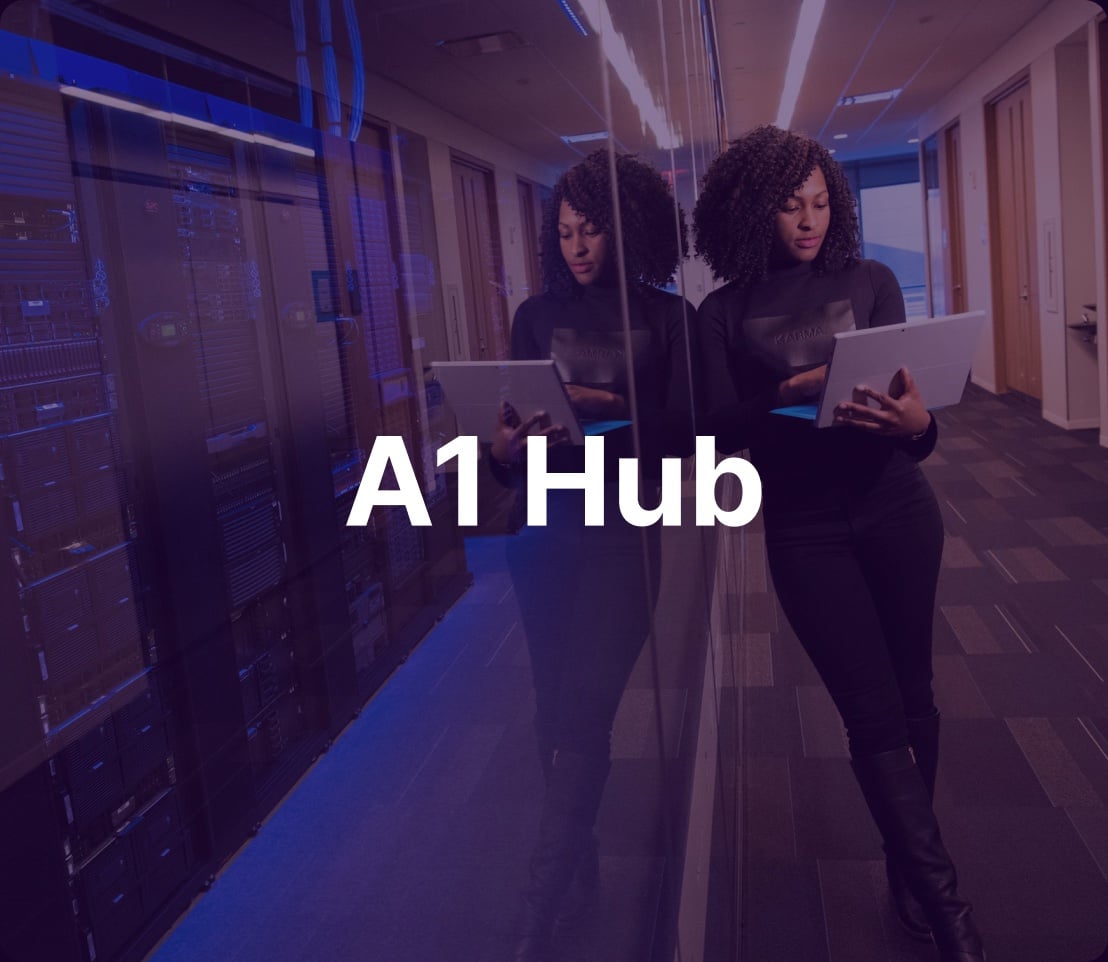
A1 Hub: engineers with laptops in a data center
4 Pillars
Core Architecture
2 Apps
Kyber & Nebulous
Multi-model
Cloud and local LLM support
Live
Expanding Platform
~0
Manual tagging remaining
Near-complete elimination.
~0
Manual tagging remaining
Near-complete elimination.
~0
Manual tagging remaining
Near-complete elimination.
AccelOne A1 Hub: governance, integrations, platform

As AccelOne developed AI applications for different business functions, it faced an opportunity to move beyond separate AI foundations and create a shared platform for enterprise intelligence. A1 Hub brings knowledge, model integrations, access controls, and usage monitoring into a single operating layer, allowing applications like Kyber and Nebulous to reuse core capabilities without compromising their independent workflows.

Built around modular APIs and provider-agnostic orchestration, the platform connects OpenAI, Google, and local LLMs while keeping governance, permissions, and knowledge retrieval centralized. The result is a scalable foundation designed to reduce duplicated engineering, improve cost visibility, and support new enterprise applications and future AI agents.

Challenge: Fragmented Enterprise AI

Independent AI tools can leave enterprise knowledge scattered, duplicate engineering work, and create inconsistent access controls. Each new application adds infrastructure and governance requirements, with limited visibility into costs.

AccelOne faced these challenges while developing Kyber and Nebulous. Both needed authentication, knowledge retrieval, model integrations, permissions, and monitoring. Rebuilding these capabilities for every application was inefficient.

The opportunity was to create a shared intelligence foundation that supports AI adoption without multiplying operational complexity.

Search and tagging had become a serious bottleneck

With millions of videos, search and tagging had become a serious bottleneck.

challenge 01

Manual tagging didn't scale

Description here.

challenge 01

Manual tagging didn't scale

Description here.

challenge 01

Manual tagging didn't scale

Description here.

challenge 01

Manual tagging didn't scale

Description here.

Engineering Highlights

The core challenge was supporting independent applications without tightly coupling their business logic, knowledge, or infrastructure.

01

Decoupling Intelligence from Applications

Standardized APIs connect applications to an orchestration layer that coordinates model selection, context retrieval, provider integrations, and execution policies. Applications, models, and knowledge systems can evolve independently.

02

Efficient Knowledge Retrieval

PostgreSQL and pgvector support storage and vector retrieval. Hybrid retrieval combines precomputed summaries with granular vector embeddings to identify relevant information and limit unnecessary context expansion and associated inference costs.

03

Governance by Design

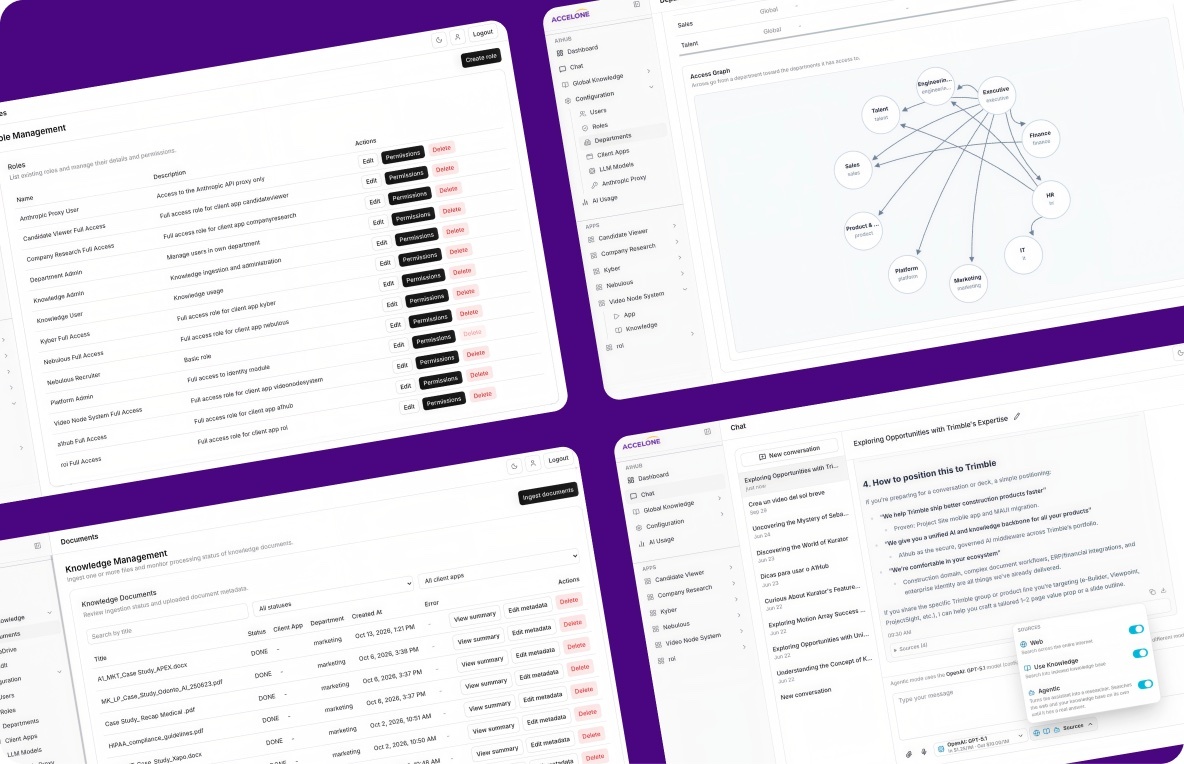
Knowledge services enforce access policies during retrieval to prevent unauthorized information from entering application context. Centralized usage tracking and audit information support governance across applications.

04

Modular Extensibility

Standardized integration patterns support additional applications, departments, and providers with fewer application-specific infrastructure changes. They also establish a foundation for future multi-step agent workflows.

A hybrid AI video intelligence pipeline built for scale

Description here.

Key Impact: Cost Reduction by Three Orders of Magnitude

One of the most significant achievements of this engagement was the reduction of AI processing costs by three orders of magnitude.

By combining on-premises transcription models with selective use of commercial APIs, AccelOne designed a hybrid architecture that:

01

Card Title

Card description.

01

Card Title

Card description.

01

Card Title

Card description.

The result was not just faster delivery, but stronger alignment around how

Monetate builds and evolves its platform.

Core 01

Shared Intelligence Foundation: Applications reuse company knowledge while respecting access permissions. That knowledge stays available even as AI models change.

Knowledge Reusability
Core 02

AI Orchestration and Extensibility: A provider-agnostic layer connects OpenAI, Google, and local large language models (LLMs), with centralized configuration, routing, and fallback strategies. It also supports future expansion into agentic workflows and tool execution.

AI Orchestration
Core 03

Enterprise Governance and Security: Controls who can access information and tracks platform activity. Company knowledge stays in enterprise-controlled storage, with defined rules for sharing data with external AI providers.

Enterprise Governance
Core 04

Enterprise Application Ecosystem: Applications retain their business logic and user experience while reusing authentication, knowledge, model integrations, and governance through standardized APIs.

Application Integration

Platform Benefits

Core 01

Faster development:

Reusable services reduce duplicated engineering.

Efficiency
Core 02

Reusable knowledge:

Authorized applications access a shared enterprise asset.

Reusability
Core 03

Cost visibility:

Analytics support AI spending and optimization decisions.

Optimization
Core 04

Consistent governance:

Common controls simplify administration across departments.

Consistency
Core 05

Provider flexibility:

Models can change without redesigning the application ecosystem.

Flexibility
Core 06

Scalable adoption:

New capabilities share an established security and knowledge framework.

Scalable
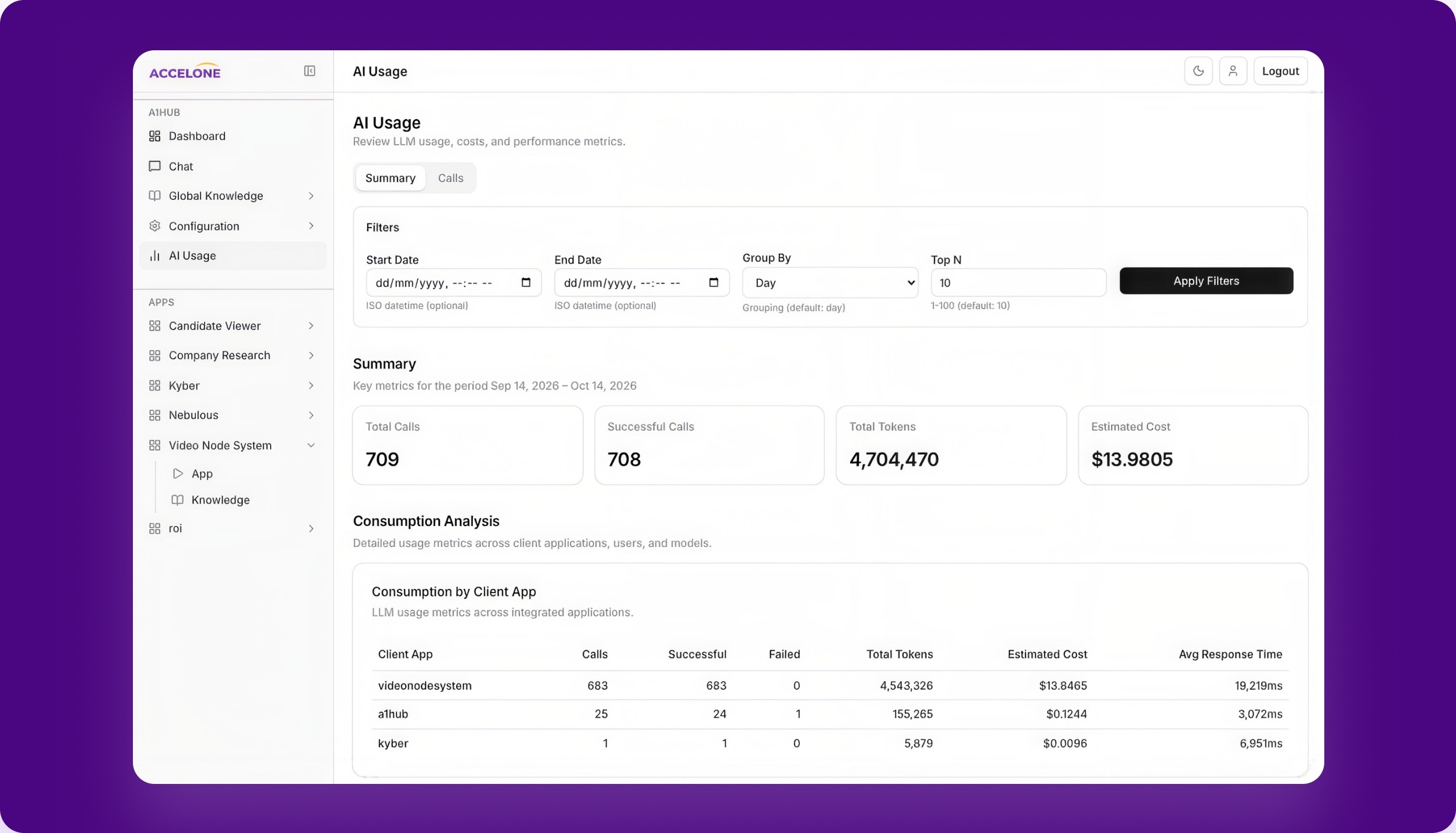
A1 Hub AI Usage dashboard: LLM calls, tokens and estimated cost by client application

Open-source intelligence, cloud applied selectively

The pipeline combines open-source models with selective cloud services, running primarily on on-prem GPU infrastructure to deliver production-grade accuracy while avoiding cost, lock-in, and unpredictability.

Tech name

Description

Open Source

Tech name

Description

Open Source

Tech name

Description

Open Source

Tech name

Description

Open Source

This hybrid approach delivers production-grade accuracy while avoiding the cost, lock-in, and unpredictability of cloud-only architectures — making large-scale video intelligence economically sustainable at 2.5M+ video scale.

AI-powered video intelligence at massive scale

A searchable, time-addressable catalogue spanning millions of hours

What was previously locked behind sparse tagging and manual review is now discoverable at scale — while balancing cost efficiency with production-grade reliability.

before

Hours per batch of manual tagging

Hours per batch of manual tagging

Hours per batch of manual tagging

Hours per batch of manual tagging

after

Minutes of spot-check per batch

Minutes of spot-check per batch

Minutes of spot-check per batch

Minutes of spot-check per batch

The catalogue is now discoverable by:

Title

Description

Title

Description

Title

Description

Title

Description

Expanding the Partnership

As the early AI and UI initiatives gained traction, the collaboration expanded. AccelOne is now contributing not only to delivery, but to roadmap planning across AI, machine learning, and user experience initiatives.

Austin describes the ongoing dialogue as productive and forward-looking:

"As we work through these initial projects, having the teams weigh in on what the roadmap should look like next has been very productive. We've gained a great set of partners and feedback voices inside of AccelOne."

The partnership now operates at two levels:

  1. Accelerating current initiatives
  2. Accelerating current initiatives

For a platform operating at this level of complexity, that alignment matters.

A Model Built on Leverage and Trust

Monetate's goal was simple: Accelerate AI and UI initiatives without slowing the organization down.

What ultimately emerged was a partnership that increased leverage across the entire business.

Senior engineers were embedded quickly. Roadmaps moved faster. AI became part of daily workflows. Collaboration tightened across teams and time zones.

The engagement reduced friction and increased output.

And the relationship continues to expand, with AccelOne contributing to long-term direction beyond the initial delivery.

At this level of complexity, sustainable acceleration is not about adding more people. It's about embedding partners who raise the standard of how the work gets done.

Delivered: Core Platform Capabilities

01
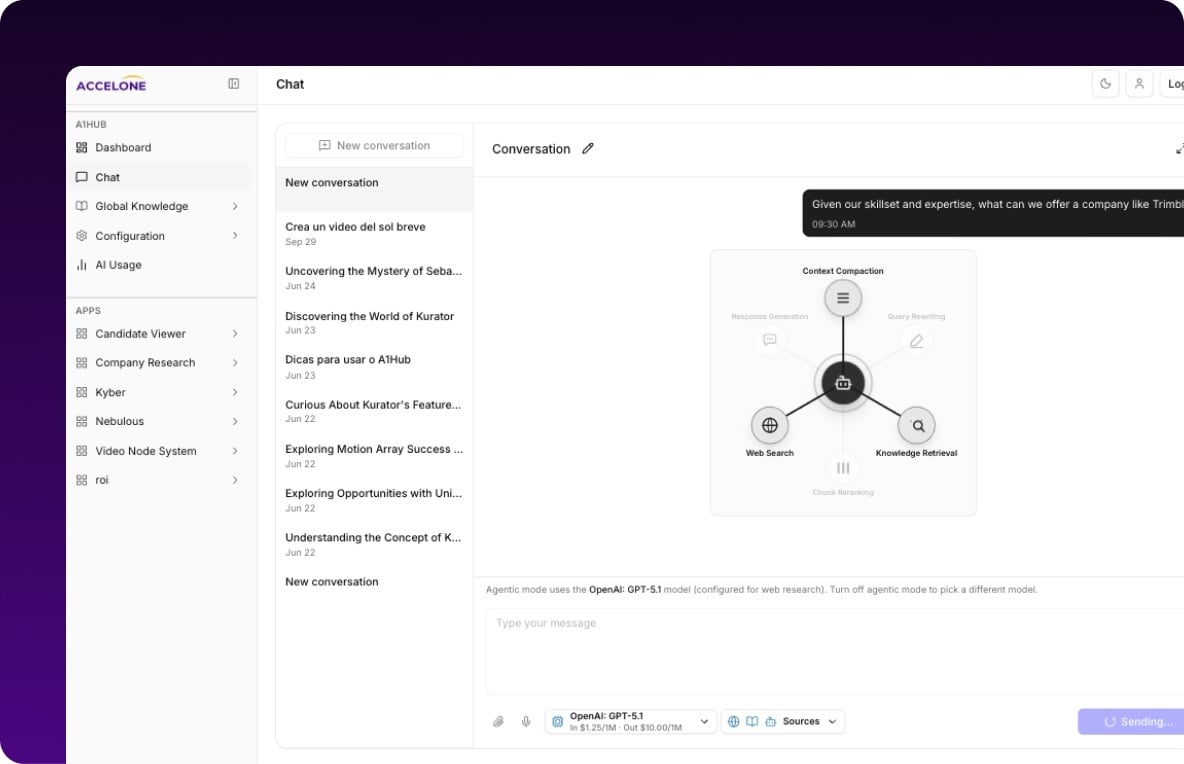
Unified AI workspace: One entry point for applications and organizational intelligence.
02
Shared knowledge services: Centralized ingestion, processing, indexing, and permission-aware retrieval.
03
Multi-provider orchestration: OpenAI, Google, and local LLM integrations.
04
Hybrid context retrieval: Precomputed summaries combined with chunk-level vector search.
05
AI analytics: Visibility into token consumption, inference costs, model utilization, and user activity.
06
Governance and data control: Role-based access, department isolation, controlled cross-department access, auditability, and enterprise-managed knowledge storage.
07
Application integration: Shared services and APIs for additional AI applications.

Business Impact

A1 Hub replaces repeated investment in separate AI foundations with shared infrastructure. This creates opportunities to reduce development costs, accelerate deployment, and improve governance and AI cost management.

Kyber and Nebulous demonstrate this approach across two business functions. Leadership gains a common view of AI usage, while authorized applications reuse enterprise knowledge within defined access boundaries.

Strategic Value: Intelligence That Outlasts Individual Applications

Models, providers, and interfaces will change. Organizational knowledge, governance policies, and institutional context need to remain reusable and independently managed.

A1 Hub provides that continuity. Its architecture supports expanding cross-functional intelligence while preserving access boundaries, giving AccelOne a foundation for additional enterprise applications and future agentic systems.

Build AI around your enterprise knowledge.

Frequently asked questions

What is A1 Hub?
A1 Hub is an enterprise AI orchestration and governance platform built by AccelOne. It connects company knowledge, AI models, and business applications through shared services and access controls.
Why is a shared AI foundation important for enterprises?
Without a shared foundation, each AI application may need separate integrations, knowledge systems, and access controls. A1 Hub brings these capabilities together, helping teams reduce duplicated work, monitor costs, and maintain consistent governance.
How does A1 Hub help companies scale AI?
New applications can reuse A1 Hub’s knowledge services, model integrations, and security controls. This helps teams add AI capabilities without rebuilding the same infrastructure.
How does A1 Hub protect company knowledge?
A1 Hub controls access by role and department. Knowledge stays in enterprise-controlled storage, and retrieval follows user permissions. Interactions with external AI providers follow configured data-handling policies.
Which AI models does A1 Hub support?
A1 Hub connects models from OpenAI and Google, as well as locally hosted large language models (LLMs). Teams can manage and change models without redesigning their business applications.
What are Kyber and Nebulous?
Kyber applies AI and company knowledge to business proposal workflows. Nebulous supports recruiting workflows. Both use A1 Hub’s shared services while maintaining their own features and permissions.

Real outcomes, measurable impact

From FinTech to Government and Enterprise, we help organizations achieve faster delivery, higher quality, and sustainable innovation.

Explore more perspectives from AccelOne